Intro
While researching this subject, I was able to find a lot of HyProCure testimonials online, including some videos of people reporting how things were going several days and weeks after having the procedure done. However, I couldn’t find any posts where a patient logged the details of their experience every day, including the day of the operation and immediately after that. So, here is my experience.
Boring Background Information
I have very flat feet. I also have foot pain in both feet, as well as a host of other musculoskeletal pain that has proven to be very difficult to treat. This includes patellofemoral syndrome (knees), SI joint pain, and lower, mid and upper back pain. I’ve done months worth of physical therapy with no improvement. I’ve seen at least a dozen different doctors and physical therapists. I’ve had multiple MRIs and X-rays and everything always comes back normal, except for the flat feet.
Here’s a video I had taken at a podiatrist’s office about a year ago which shows how badly out of whack my feet were:
Constantly dealing with foot and knee problems over the last ten years of my life has made it difficult to do ordinary tasks such as being on my feet or walking continuously for more than an hour. Being able to run a few miles a week is a goal that I’ve been trying to reach for years. I tried running in various heavily-padded shoes but even a half a mile would lead to bad foot pain for days afterwards. I tried minimalist shoes (Vibram Fivefingers and Merrell Trail Glove) and adopted the “barefoot” running style, which definitely gave me the best results, but I would still end up with a lot of foot pain for days afterward even after running distances as short as one mile.
Many doctors and PTs have advised me that sometimes bad foot alignment can lead to problems upstream in the knees, hips, back, etc. so a lot of effort has gone into trying to fix my feet.
The first physical therapist I saw tried to train me to consciously raise my arches and stand properly on my feet. This of course requires far too much conscious ongoing effort to maintain correct foot orientation all day every day, and even when I tried my hardest, it wasn’t helping. It’s also impossible to judge what “standing correctly” feels like when all you know is how to stand flat-footed like your body wants to. Maybe this approach works for people with slighly fallen arches, but not a more extreme case like me.
I tried all kinds of orthotic shoe insoles. Off-the-shelf ones were more comfortable than the insoles that came with my shoes, but no gave me no improvement for any other issues. I tried custom orthotics from a special footwear and orthotics shop. Expensive, comfortable, and slightly helpful at first, but no more than ~10-20% improvement. Finally, I tried even more expensive and aggressive custom orthotics that I got from a local podiatrist. These were uncomfortable, and they actually made every kind of foot pain I was experiencing happen more frequently and severely, despite the podiatrist’s insistence that the orthotics were a perfect fit for me and really corrected my foot orientation. After three or four follow-ups telling the doctor “I’m getting continuously worse the longer I wear these,” and being told “Well, but these are such good orthotics, though,” I never went back to that doctor or wore those awful things again.
Finally, while chasing down a seemingly unrelated series of hand and arm problems and seeing several hand doctors, I found one who made the connection that I likely have a genetic connective tissue disorder such as Ehlers-Danlos (EDS) or some other similar form of joint hypermobility. I consulted a rheumatologist who concurred with my hand surgeon’s opinion. While I have not had the very expensive (and difficult to obtain) genetic testing to confirm this diagnosis with 100% certainty, it explains many of the joint and soft tissue issues I have suffered with my entire life, which no doctor before him had identified as a possibility. I mentioned my persistent foot issues, and the hand surgeon referred me to Dr. David Gent for consultation on something called “HyProCure.”
HyProCure
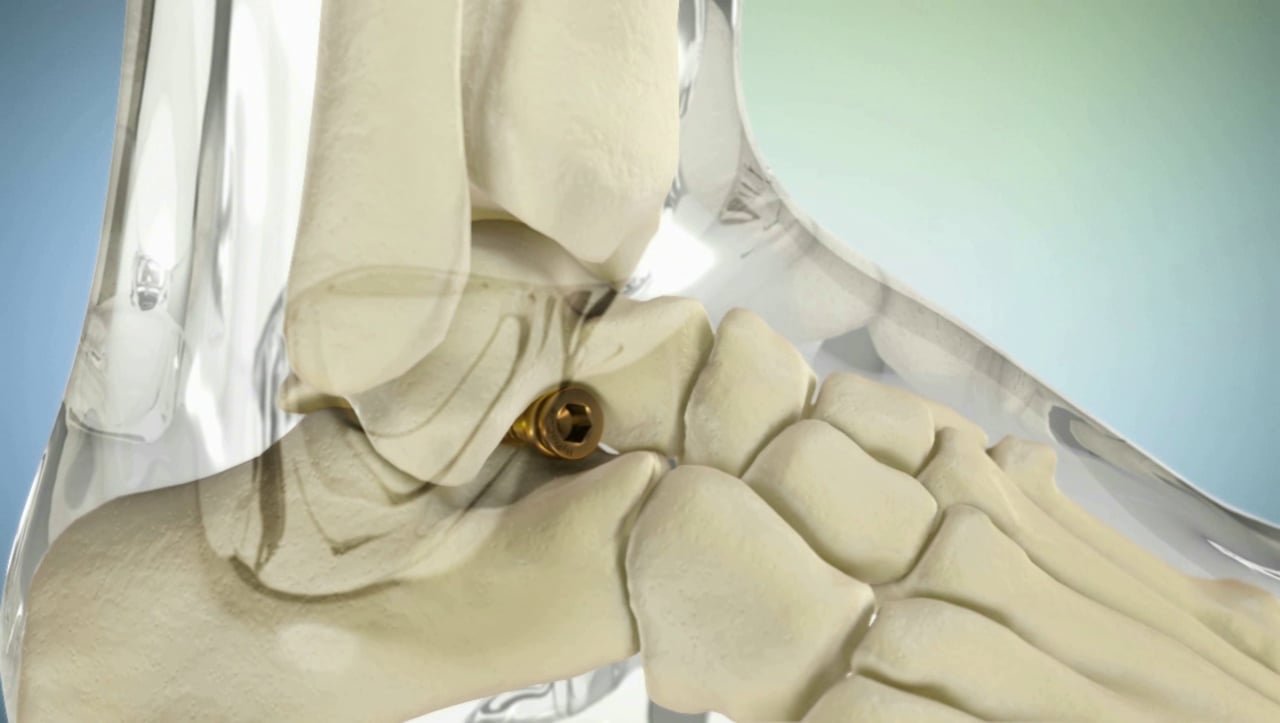
I won’t go into a ton of detail about what the procedure entails, as you can get all of that information from their official website as well as this video which shows an animation of how the procedure is done.
The short explanation: Having flat feet, technically called hyperpronation, is caused by bones in the foot sliding relative to each other in a way that they are not normally supposed to do. This results in the arch collapsing and the ankle leaning inward. The way this treatment fixes it is by inserting a small piece of titanium between two of those bones, which stops that incorrect sliding motion and results in a properly-aligned foot. Once the implant is installed, you can’t help but stand with a proper arch, like a normal person.
The Pre-Op
I visited Dr. Gent and he determined that HyProCure would be a good fit for me. He explained that he has seen many patients with joint hypermobility and/or EDS who have had great results with it. Unfortunately, it is still commonly considered experimental by many insurance providers, including my own, so the operation itself had to be paid out-of-pocket, although all the pre-op and post-op would be covered. Insurance would also cover the operation to remove the implant if it turned out that it didn’t work for me. I decided it was worth it.
I opted to do the procedure at Dr. Gent’s office in Bremerton, WA (I live in Seattle) without general anesthesia. The operation is always done on one foot at a time, so we chose the right, as it’s by far the most painful of the two, and also because my left leg is half an inch longer than my right — installing the implant adds almost 10 mm to your overall leg length, so it’s best to start with the shorter one first.
A week beforehand, I was prescribed a few pills of diazepam (anti-anxiety) for the procedure itself and a bottle of oxycodone (narcotic painkiller) for the post-op pain as well as some hydroxyzine to help mitigate some of the painkiller side effects. I arranged for a friend to drive me out to the clinic on the day of the procedure.
The procedure – Day 0
On the way out there, I took some of the diazepam, which had me feeling pretty relaxed. However, once I got to the clinic and up onto the operating table I started to get kind of freaked out, so I took another pill, which helped a bit. I opted to have a barrier hung between my upper body and my legs so I wouldn’t be able to see the actual surgery. (Apparently, some people actually want to watch as it’s being done — I would never be able to handle that.)
Dr. Gent’s assistant started by scrubbing my foot thoroughly clean and preparing it. Then I received several injections of anesthetic around the ankle area, which was by far the worst part of the whole procedure. Extremely painful. Then we sat around for about 15 minute waiting for that to kick in. With my foot sufficiently numbed up, Dr. Gent began the procedure. I didn’t feel any pain, but I definitely could feel the pressure of the incision being made and the necessary ligaments being cut in order to make room for the implant. Unsettling, but I tolerated it okay.
The doctor used a set of tools to test-fit various sizes of implant to see which was best for me. This was a very disconcerting process and I was glad to be on a pretty heavy dose of the “chill pills” at this point. The last size he tried felt very uncomfortable, which I mentioned. The doctor said that was good feedback and that it let him know that he needed to go down at least one size. Eventually he made a decision and proceeded to install the actual implant and stitch me back up.
After applying bandages, some X-rays were taken, first with me lying on the bench and then one while standing and putting my weight on the foot. Everything looked OK, so a padded boot/sandal/shoe thing was strapped to my foot and I was sent on my way. The nerve block was still in effect, so I wasn’t in any pain, and I hobbled out to my friend’s car without crutches.
The first night, with my foot still thoroughly numbed, I was able to walk around the house quite a bit without pain. However, later I checked the bandages and found that I had bled considerably, soaking through almost all of the layers. I stayed on the couch after that, and used crutches every time I needed to get up to use the bathroom. My girlfriend helped me re-dress the upper layers of bandage before bed and I propped my foot up on some pillows before going to sleep.
Day 1
In the morning we replaced bloody upper-layer bandages again and found that the bleeding seemed to have continued a bit but stopped during the middle of the night. The underlying layers had fused into a big block of clotted blood. I vaguely remembered Dr. Gent’s assistant telling me not to try to remove that but to just leave it alone, which I did.
I spent the first few hours of the day using crutches to get around and trying to avoid putting any weight on my foot. I was continuing to take oxycodone every 4 hours to keep the pain under control, which I could tell was necessary because about 3.5 hours after every dose, I could feel fairly intense achy pain starting to come back. It made me itchy and irritable. I’m really not a big fan of prescription painkillers.
Overall this day was pretty rough. I spent most of it on my computer with my leg propped up or on the couch, and I had to have my girlfriend do virtually everything for me.
Day 2
I woke up to a pretty achy foot. I had had it elevated most of the night. I applied an ice pack for the first time which brought considerable relief. I used this special compression ice pack that had I bought a year or two ago for some ankle pain I was having at the time, and it worked well for this, too.
Once I got up and moving, this day turned out to be much better than the one before. I found out shortly after waking up that I was now able to put weight on my foot and even hobble around without a crutch if I was careful. The foot didn’t want to rotate forward or back very much, and I had to be careful to keep my weight on the outside of the foot — letting my foot relax would cause my foot to try to hyperpronate, which led to the HyProCure doing its job, and a lot of pain around that area.
One of the biggest sources of discomfort at this point was the bandage itself. The caked-on mass of clotted, bloody gauze was irritating the skin underneath. I couldn’t really do anything about this so I just tried to stop and rest any time this felt like it was getting too bad.
I still spent most of the day sitting around and keeping my foot elevated, icing it occasionally, but I managed to move around quite a bit as well, although I still hadn’t left the house since the procedure. I also had my first bath since the procedure; as I couldn’t let the bandages get wet, a shower was impossible, so I took a bath with my leg hanging over the edge of the tub.
Day 3
I was able to come down on the painkiller dosage a bit and began the process of tapering off of the pills. Walking was still tricky in the morning. I tried wearing the boot-like sandal that I had been sent home with and found that I couldn’t wear it due to the very irritating, blood-encrusted gauze stuck to the wound. None of my other footwear would work, either. This was Christmas Eve and I was supposed to attend a family function, so I needed to find a way to get myself out of the house wearing something more than a sock over my foot.
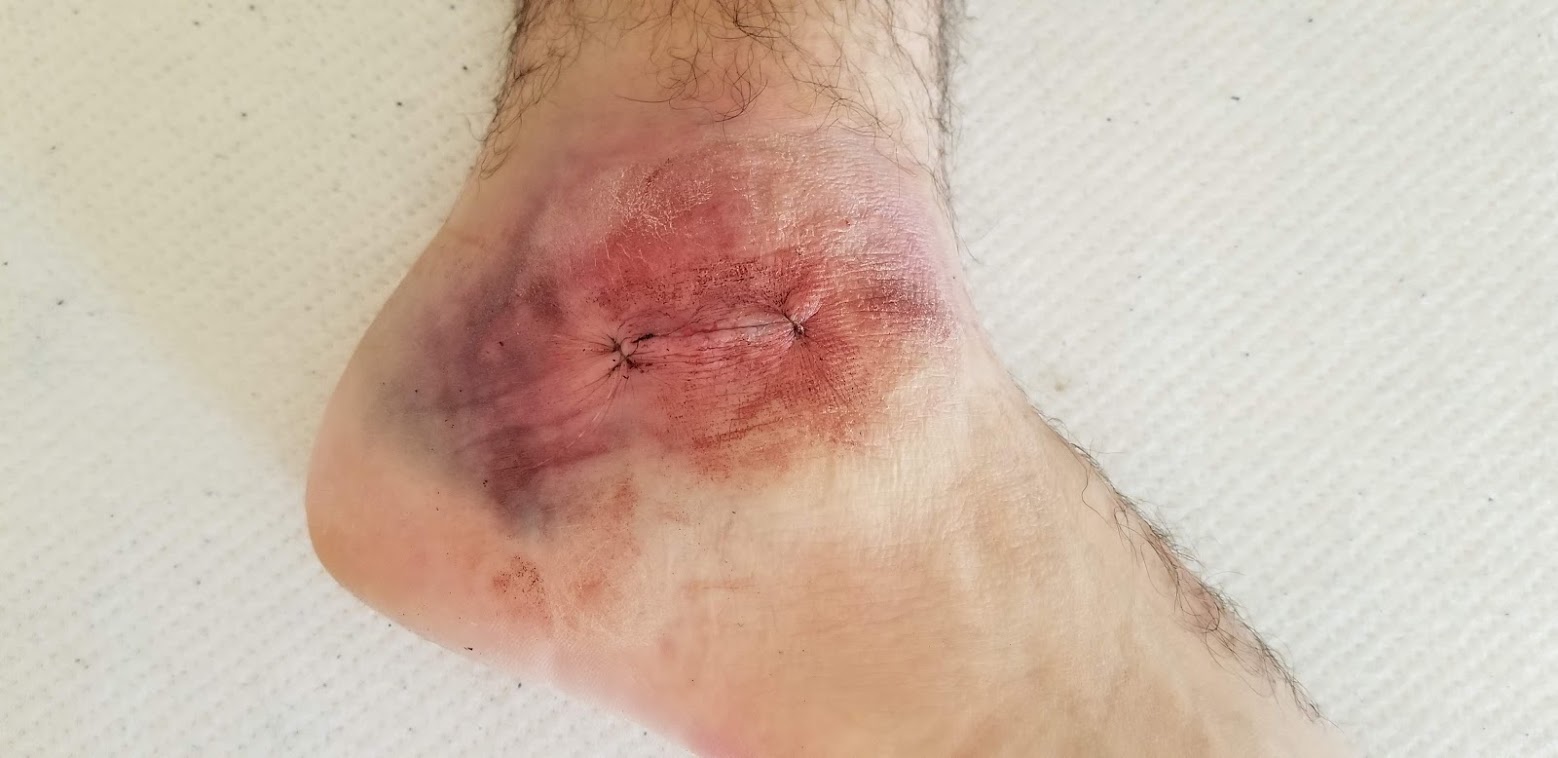
Finally fed up with the bandage, I called Dr. Gent, who gave me permission to remove all of the bandages and gauze and re-dress the wound. I had to peel all of the gauze off rather delicately, which took about ten minutes, but eventually it all came free. There was a tiny bit of bleeding/weeping from the wound, so I left the bandages off and elevated the foot for about an hour to let it all dry out. There was a significant amount of bruising all around the incision. A photo of the fairly ugly undressed wound at this stage can be seen here, if you’re curious — but don’t click that link if you’re especially squeamish.
After re-dressing the wound, I was able to put my normal shoe on with the laces loosened all the way. For the rest of the day I was able to walk around with mild difficulty and even managed to do some reorganization in my garage.
Later, I was able to leave the house for the first time since the surgery to visit my family for Christmas Eve.
Day 4
Similar to day 3. I experienced some bleeding, just enough to soak through the gauze and stain my sock, but nothing major.
Day 5 – Post-op visit
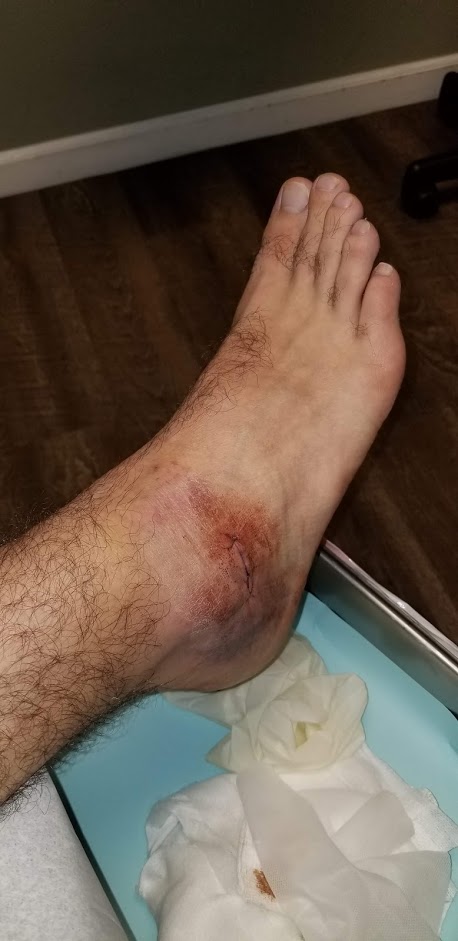
I drove myself out to Bremerton to visit Dr. Gent for the follow-up visit. He inspected the surgical site and reported no signs of infection or other issues. He advised me to wait two more weeks and then get the stitches removed at my regular doctor’s office. Here is a photo of the surgical site that day. Less bruising but still pretty gross.
At this point, I was still taking baths instead of showering in order to keep my foot dry, which was driving me nuts. I was advised that I could begin showering if I put a waterproof bandage over it to keep it dry. The product I ended up using was Nexcare Tegaderm which worked really well. It’s much cheaper on Amazon than it was at my local drug store, so if you’re planning to try HyProCure, order a couple of boxes in advance. After showering, I would either replace the Tegaderm with an ordinary large band-aid, or just leave it on. The only issue I had with the Tegaderm was that it sometimes would start to peel off while I was asleep at night.
I did not experience any further bleeding or weeping after this day.
Days 6-14
Things gradually improved every day. Standing for more than 15 minutes led to a lot of discomfort. My limp was pretty severe, but by day 14 I was walking almost normally.
On day 9, I went to a football game, which involved walking several miles and climbing several hundred stairs. It wasn’t an issue. The biggest problem I had was walking on the coarse gravel in the parking lot. Walking on uneven surfaces is very uncomfortable. Funnily enough, for much of the day, my other foot and leg were bothering me more than the side I had the surgery on.
Initially after the surgery, when I would relax my foot and put my weight on it, this led to the arch trying to collapse and the HyProCure stent blocking the motion, which was very uncomfortable. I had to concentrate on rolling my foot to the side to force the arch upward when standing or walking. By day 14, this was less of an issue as my foot continued to heal internally around the implant.
Day 15
Walking and climbing stairs are now very easy to do. I can climb ladders and wear any pair of socks I own. Standing for more than 15 minutes is no longer uncomfortable, but I certainly can’t be on my feet for hours at a time at this stage.
I recorded this video showing the comparison between my “stock” left foot and my “modified” right foot. You can immediately see how badly my left foot’s arch collapses; my heel and my leg are completely out of alignment with each other. The right foot isn’t perfect, but it’s a dramatic improvement.
During the video I start by standing with my feet relaxed. Then, I roll them outwards and try to create an arch, like in the first video. Then, I relax them again. You might notice that my right ankle is shaking a little bit; that is a combination of me allowing the implant to do its job but also still consciously trying to hold my foot in proper orientation a bit. The shaking is involuntary. It is still a little uncomfortable to relax that foot and put my full weight on it. This has been getting a little bit better every day.
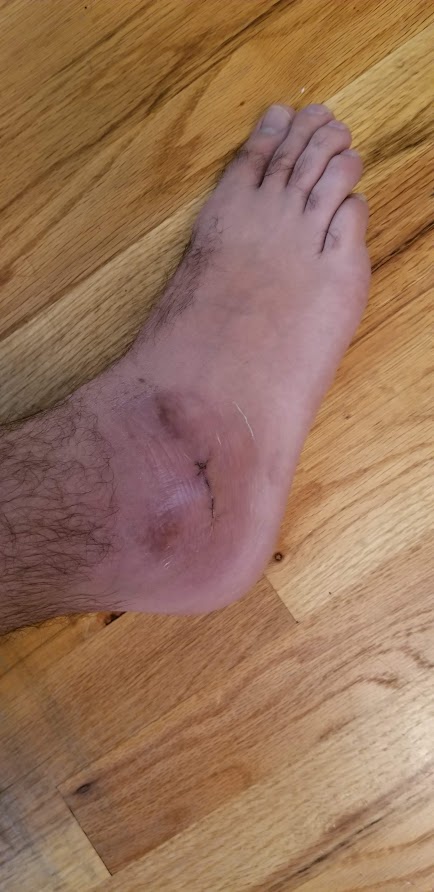
I also took this photo showing the surgical site. There is a Tegaderm bandage over it in this photo.
Throughout this healing process, the only pain I have experienced in my right foot is post-op pain: pain at the incision, and pain inside the foot where the implant was placed. All of the various kinds of foot pain I was suffering in that foot in the week leading up to the surgery are completely gone. It’s pretty amazing.
I finished writing this post in January, but never got around to coming back and publishing it, hence why it is dated April 14th.